


I ran across a couple of rants over the weekend that will save me the effort of documenting my thoughts on the two subjects. One is this article on how dysfunctional the US Senate has become. As a small state resident it's theoretically against my interests to argue for reform of the Senate, but as a progressive reform would clearly result in legislation more to my liking. Another is this article on the hubris of Cerberus, which clearly never should have bought Chrysler to begin with. However, to be fair, I think the newly independent Chrysler was doomed from the start because it was saddled with an awful product lineup thanks to years of mismanagement by Daimler. Even if Cerberus had executed perfectly, the business cycle would have caught up to it before any new products made it to market. At the time of the sale, I hoped Magna would buy Chrysler because it was a manufacturing company that already assembled Chryslers in Europe. The conventional wisdom was that Cerberus really wanted Chrysler Financial, and that sounded to me like Cerberus was going to just slash costs and then dump the car-making business. I thought Magna would take the product side more seriously (though I had no proof of that). Anyway, that's all ancient history - except the products, which still kinda suck.
The 'Cash for Clunkers' program (a.k.a. the wittily named Car Allowance Rebate System) has been declared a resounding success, with buyers and dealers loudly requesting more. Congress has satiated them for the time being with an additional $2B allocation on top of the original $1B. Even the net gas mileage improvement has been higher than expected.
But is the program really a success, meaning has it increased the common good? Or are the politicians just bribing voters with other people's money? Consider:
As I opined elsewhere on the tubes, I didn't really mind the program as long as it was temporary. To me, the main goal appeared to be to help dealers and, by extension, manufacturers, by clearing inventory. Adding another $2B to the program will make it hang around much longer, and the unintended consequences will increase to a point where they really should be taken into consideration.
But they won't be. Who can argue with success, or the illusion thereof?
Update 2009-08-11: Some non-mendacious funkiness with the reported numbers has given a slightly distorted view of what vehicles are selling. Explanation here.
GM is out of bankruptcy in a shockingly short amount of time, like Chrysler. That the transition went so fast is good, though I foresee lawsuits of varying merit following the new GM for a while.
Unlike the Chrysler-Fiat alliance, GM did have a lot of product overlap to shed in North America during bankruptcy. And I don't think management fully eliminated it. There is almost complete duplication between the Chevy truck lineup and the GMC lineup, especially since GMC killed their two larger commercial truck platforms. Chevy and Caddy occupy different market segments, but what is the role of Buick? American luxury? Huh? The marketing weenies have their work cut out for them in this regard. The decision to keep Buick may have more to do with its strength in China than its future prospects in North America.
As for the dead brands, killing HUMMER and Saab were no-brainers: they were both close to death already. Saturn, too, has had a tremendous decline in sales over the past two years. But the basic concept of the brand - a limited range of competent cars sold in a low-pressure atmosphere - was ruined several years ago by bureaucratic infighting at GM headquarters. It became just another engineered badge. Pontiac had been an engineered badge for years, supposedly with more a more sporty, performance oriented lineup of cars than Chevy. But Chevy offered performance versions of its vehicles, and GM's ultimate performance vehicle remained with the brand. In the end, Saturn, Pontiac, and Chevy all competed for roughly the same customers at the lower end of the market. Chevy was the logical one to keep.
For reference, here are the June sales numbers for GM from 2009 and 2007:
Overseas (meaning outside the US+CA market) GM is keeping everything but Saab, which will be bailed out by the Swedish government via Koenigsegg. GM will retain a minority ownership in Opel and Vauxhall under a tentative agreement with Magna. The remaining operations are GM Daewoo (which are badged as Chevrolets in most of the world), Holden (AU-NZ brand with one home-grown platform), GM China (Buick, Caddy, and others), and Wuling (a joint venture with CN-only platforms).
Holding patterns are boring.
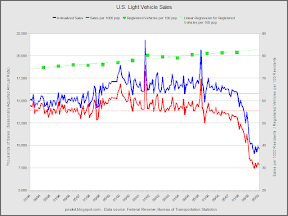 Not much change here. (Note: I have switched data sets for the registered vehicles from 2 axle vehicles to all vehicles, so the numbers for vehicles per capita are higher.)
 Absolute sales are down from last month, but that's a seasonal pattern.
 This month's new graph is once again not terribly revealing. Note that I have classified the brands based on where a brand's operations are based, and not on country of production or location of a parent company.
The deal for Fiat to partner with Chrysler is done. I think that everybody - Fiat, Chrysler employees, the UAW VEBA, the USG, the remaining dealers, and even the whiny creditors - got more with this agreement than they would have if Chrysler had been liquidated. The biggest losers are whoever had planned to cherry-pick things like the Jeep brand or the minivan franchise or various other bits of IP out of the wreckage.
What I haven't seen published is a side by side comparison of Fiat and Chrysler. A lot of people have said it is a good match, and a quick glance at the product portfolio suggests they are right. But shouldn't we do more thank kick the tires? (Sorry, couldn't resist.)
 Here's a rough comparison of the companies. While the automotive divisions are about the same size, FIAT as a whole is a much larger conglomerate. So even though it contributed to no cash to this deal, Fiat should be able to bring a lot of resources when needed in the future.
 At first glance the car lineups of the two companies don't overlap much, which is good. But closer inspection reveals a major hole in the D-car segment. The Sebring/Avenger sedans are awful, the Croma is a wagon-like thingy that doesn't sell very well, and while the 159 is nice, the platform is probably too costly to adapt to lower market segments. The Croma has the added problem of being based on the GM Epsilon platform, which underpins the Malibu and a bunch of other GM vehicles. I assume the Fiat has the rights to the IP, but the question remains as to whether it can successfully improve this platform as much as it's larger rivals are sure to. This hole is a big problem because in the US the mid-size segment is the best selling among cars.
There are additional problems. For instance, Fiat's C-segment cars are all hatchbacks, which aren't very popular in the US compared to sedans. Most companies have multiple body styles in that segment (3 and 5 door hatchbacks, sedan, wagon, coupe), even if they aren't all sold in the US. Fiat's B-segment cars are also all hatchbacks, but body dimensions in this class make any other shape of low utility. Another problem is the lack of smaller sports cars. The Sebring convertible still exists for now, and sells great to rental fleets and middle-aged women. But currently Fiat has nothing to compete with vehicles like the Miata or Solstice/Sky. Chrysler's E-segment cars are about to be refreshed, and the platform could be used by Alfa to fill the hole in that part of it's lineup. But they are heavy and thirsty, and thus could suffer from another gas price spike. On the other side, the Thesis is an oddball I can't find much information about, and the Quattroporte is both tremendous and tremendously expensive.
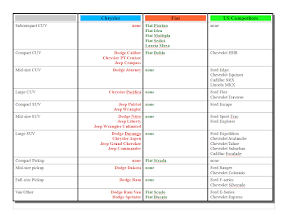 In the so-called "light truck" arena the combination looks good at first as well. (I should note that the line between CUV and SUV has become rather blurred, and some of the categorizations I've made are debatable. Also, I put minivans on the cars page for space reasons.) Fiat has a very odd mix of vehicles piled up at the small end of the CUV market. I don't think any of those would sell much in the USA. Unfortunately, the Caliber/Compass twins aren't all that good either. The Journey is a little better, and potentially could be re-used in Europe. Of the more pure SUVs, most of the models just aren't suitable to either European tastes or European roads. This includes the Pacifica (which has been scheduled for cancellation anyway), the Durango/Aspen pair, the Nitro/Liberty pair, and the Commander (also scheduled for cancellation). The Wrangler and the Grand Cherokee do have potential to sell in Europe and elsewhere. The pickups don't. Fiat already has a number of commercial vehicles, so the Mercedes-derived Sprinter and old-school Ram Van are likely to die soon.
That leaves the iconic (but scheduled for cancellation) PT Cruiser, and the mini-vans, where the sizes are close but not quite the same. The Ulysse/Phedra pair are about the size of the Chrysler minivans from two product cycles back. The Grand Caravan/T&C pair still sell well, but the market isn't as popular these days. Honda, Hyundai/Kia, and Toyota have taken market share (as well as driven Ford and GM out of the category) Here the combined companies would be best served to continue to the Chrysler platform as-is, but slightly downsize the Fiat platform. The PT Cruiser is very dated, but still sells. I think the plan is to build the US-market 500 in Toluca plant, so there is no chance of the PTC continuing.
So, to summarize, the overlap is minimal both in terms of existing product and sales areas. However, there are major product holes that need to be filled very soon. I still have doubts as to whether Chrysler can survive long enough to get the small Fiat models in the showroom and selling well. I also have doubts as to whether the combined company can make a competitive mass-market D-segment car because it has been a chronic problem for both companies. Arguably Fiat has never had a good car in this class, and while the original "cloud cars" were competitive when they were first brought out, that was over 15 years ago now. Chrysler - under Mercedes' lousy management - let the original platform fester, and then was forced to work with a half-baked platform donated by Mitsubishi before Mercedes gave up its ownership in the Japanese firm.
It will take several months to see how the new combination is working. The extended shutdown at Chrysler has cleared a lot of inventory which should help the remaining dealers. But the car market is still much smaller than it was a year or two ago, so it might be that the remaining Chrysler plants can't be run profitably.
A so-called "cash for clunkers" program was appended to a military spending bill and passed by Congress on Thursday. It really is a pretty lame program from an fuel economy point of view, as is demonstrated here as part of a larger rant. Of course, fuel economy wasn't the primary driver of the program - increasing car sales was. And like most poorly thought out government programs, there are plenty of unintended consequences.
Could a good trade-in program be designed? Probably. I've been noodling on one but the futility of it all is overwhelming me right now. Maybe I'll haul my plan out some other day.
This data set doesn't tell me too much.
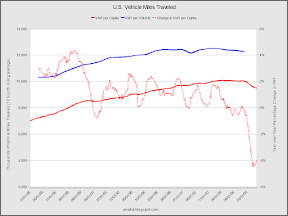 Vehicle miles per vehicle has been roughtly flat for a decade. The data for vehicle registrations is annual so we won't see any change in 2008 for a while. My guess is that VMT per vehicle will go up in the next few years as the fleet size declines and family/household members share fewer cars.
As far as VMT per capita goes, I think it is a slightly trailing indicator of economic activity. That the rate of decline appears to have stopped increasing is good news less bad news for the economy. I'll try to compare VMT to petroleum use in the next few days.
Positive second derivative! Ok, I didn't check that, but at least for Ford and GM the rate of decline seems to be lessening. Toyota, however, got hammered again.
 The bottom has definitely been found.
 Lincoln wins the least bad brand performance title this month by actually increasing sales. Izuzu seems to have finally worked off its US inventory.
 Subaru remains at the top here.
 New graph! Entirely unsurprising contents! (Except July 2005 - what happened there? Was that an employee pricing month?)
 Another new graph. This one doesn't tell me much.
Unfortunately, I am now known across the blogosphere for producing really bad graphs.
Maybe I should work on that.
It looks like auto sales have found a floor between 9 million and 10 million SAAR. Now the question is what will become the new normal. 12 million? 15 million? 10 million? I think we'll see 10 million this year, 12 million in 2011, and 14-15 million for a few years after that. Recently built cars (after 1995 or so) last longer and sales from 1999 to 2007 were artificially high due to the internet and then the credit bubbles. That means there is a glut of "car capacity" in the country.
My prediction about Chrysler has been right-ish so far (my timing was off). For the workers' and retirees' sake I hope Fiat succeeds at leading the new venture. But despite Marchione's record, I am not optimistic. And there has been no news about whether the bankruptcy period will be short, which it needs to be.
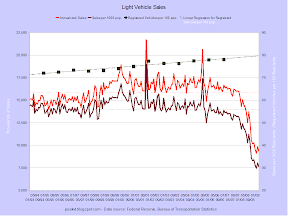 That's some serious cliff diving! (It's also non-zero-based, but it always is.)
Looks like the parachute was vastly undersized. Both the absolute and adjusted numbers showed downward acceleration. The results for the three largest Japanese companies were off by ~28%. GM, F, and the company formerly listed as C saw declines of 49%, 41% and 55%. I don't see how C can survive on those numbers.
 Not much to say other than "cliff-diving".
 Both Hyundai-Kia and Subaru had modest increases, which in this environment is like doubling sales. For individual brands, Chrysler saw the worst, with a staggering 69% decrease from January of 2008. Since January of 2006 Chrysler sales have fallen by 78%, beating Pontiac by a few points for the worst performance among active brands.
December auto sales were still horrid in a year-over-year comparison, but due to seasonal variations the actual numbers were up about 15% from last month. Only Chrysler and Kia registered month-over-month declines. On the other hand, Mini was the only brand to register year-over-year increases.
 Here's the annualized and per capita sales.
 Here's the same thing but zoomed in, just because.
 Here's sales by brand.
 And here's sales for groups and major "independents".
 Finally, here's a non-sales graph that I found slightly interesting.
Easy to say if you make it through. That's still in doubt for the Detroit 3 unless sales pick up. My guess is sales will be 10-11 million in 2009 and 11-12 million in 2010. That won't be enough to keep Chrysler going, or Ford and GM profitable. Update: Or Toyota.
 Sadly, Saab sales continue to tank despite making good cars. Happily, Hummer sales continue to tank, to the relief of eyeballs across the nation. MINI had the biggest gains over the past year, but sales of the single-model brand are still miniscule (heh).
 Chrysler is the worst performing group, though Nissan isn't that far behind. Ford, Honda, and Toyota had nearly identical declines in November 2008.
At last, a (choose one of: plan|bailout|rescue|giveaway) for the American auto industry emerges. It's just a bridge to March 31, but at least the problem was punted into the Obama administration, instead of being allowed to snowball into "disorganized" bankruptcies and possible destruction of the sector.
Just to review, sales across the globe are plummeting. Canada, Spain, and Sweden have announced plans, while France, Britain, and Germany are considering plans. Japan will continue providing aid via currency intervention.
Why so many Americans insist the country be a free-trader in a world of mercantilists continues to baffle me, especially since the results are not good for the country.
In what has a good chance of going down as the worst strategic decision since the 2003 invasion of Iraq, Republicans last night voted against the Detroit bailout bill over the issue of forcing the UAW to make wage concessions before other stakeholders such as shareholders, bondholders, suppliers, and dealers.
That's right: before.
As the party of management and the wealthy, Republicans have long fought unions. This time, however, their union-busting efforts are about to become economy-busting efforts. On top of being stupid, what makes their move outrageous is that labor for final assembly amounts to about 10% of the price of a vehicle. And what makes their move even more outrageous is that the party of free enterprise is insisting on micromanaging blue-collar worker pay without micromanaging white collar pay (though it must be said Democrats efforts to control executive perks has gone overboard).
And the average water-carrying management tool in the comments at economy-focused blogs thinks that the Democrats are going to take the blame for this. Instead, the Republicans have just conceded every major race in the upper Midwest for a generation.
Update: Bush to the rescue! (I can't believe I said that.)
Looks like the Bush administration is going to authorize a loan using TARP funds - which the Democrats had been pushing for all along.
Update: Never underestimate the kabuki factor.
November sales across the auto industry collapsed. For the Detroit 3 the declines were:
Today was also the deadline for the Detroit 3 to submit their "restructuring" plans. Their "loan" requests were:
Elsewhere, far too many people remain indifferent or opposed to bailing out the Detroit 3 in some manner. As I outlined below, letting one or more fall into an unplanned CH11 would be very dangerous and could lead to a meltdown of all three.
Update: Chart Pr0n!
 Look at that drop-off. There has been a slight downtrend of per capita sales over the past decade, but starting in September sales absolutely collapsed. Annualized sales should set a new record low next month, and per capita sales will do so a second consecutive time.
The performance by the Detroit 3 execs in Washington last week was miserable. Absolutely pathetic. Beside the very predictable PR disaster with the private jets, and the very obvious realtime disaster of not budging on their salaries, they had no plan for using the money they were asking for. No. Plan. These guys run billion dollar companies?
My interest in bailing them out went down substantially, and so did that of Congress.
Apropos to the testimony, though it is obvious that the downfall of the Detroit 3 down is primarily a management failure, it's nice to find this supporting anecdote from Bob Sutton.
Well-known banking industry researcher Chris Whalen mentions auto-related CDS in this long post.
The $70 dollar per hour lie (yes, L-I-E) is circulating again. Felix Salomon shoots it down here. Folks, it's not hard to differentiate between compensation and overhead.
Update: A contrast between how the Detroit 3 and Toyota value their employees can be found here.
Update: A premier bankruptcy expert weighs in on restructuring here.
Update: The views of two auto industry experts are similar to mine.
Update: A detailed look at the 2007 labor agreement shows that the UAW made significant concessions (mostly at the expense of new workers, however).
Update: A veteran Japanese auto exec gives his views on the Detroit management culture.
