Showing posts with label Banking. Show all posts
Showing posts with label Banking. Show all posts
Friday, January 27, 2012

Thursday, December 17, 2009
Bailout Ben Blows
In case this gets taken down:
Why is three strikes not an out around here? Bernanke 1) helped create the biggest financial mess since the Great Depression, 2) is advocating a high-unemployment Fed policy for the foreseeable future, and 3) thinks the budget should be balanced by cutting entitlements because "that's where the money is." Not only is Bernanke bad for average Americans, he's going [to] hurt Democratic politicians, which will lead to Republicans being elected, which will be bad for average Americans.Which means I've changed my backhanded semi-endorsement to outright opposition for reasons described above. Fortunately, one of my Senators agrees.
Update 2009/12/25: Baker utterly destroys Bernanke.
Thursday, July 16, 2009
3-D Green Eyeshades
This brief post by Salmon reminds me that TBTF is here to stay, despite numerous calls to break the big banks up. Given that, what should we do? The so-called "tax" in the linked article would be a partial fix, but I don't think its enough. I would like to see a multi-dimensional insurance fee (or tax if you prefer) based on risk, size, and leverage. Some qualitative measures could be thrown in as well - stability of funding (deposits vs. brokered deposits vs. credit markets vs. whatever), strength of internal risk analysis, corporate structure, over-concentration or over-diversification, and more I haven't thought of. The idea of making the fees counter-cyclical should be implemented as well.
Of course, such a wonderfully precise system is about as likely as breaking up the big banks - both are blocked by the fact that the banks "own" the Senate (per Dick Durbin). But I can still dream, eh?
Monday, May 11, 2009
Timmeh Tuh: Bankster Boogaloo
I finally got around to reading the huge profile of Geithner in the NYT. It's discouraging. We cannot restore the financial system to its 2007 or 2005 state; it needs a complete overhaul and a new outlook. And now I am quite confident reform efforts will amount to squat.
Maybe we'll see better results on health care.
Thursday, March 19, 2009
Timmeh
It looks like I was a bit too optimistic about Geithner back when he was nominated, though I was hardly thrilled at the time. The Larry and Timmy team isn't doing any better than Hanky and Bennie - and Bennie is still in the mix, buying everything that vaguely resembles a security. The Big Sh*tpile™ is still just that, and it seems to be growing, somewhat like fractals do, into Eastern Europe. Other bad economic news abounds - far too much to catalog.
Anyhoo, my recommendation is still the same: nationalize pre-privatize (though I might reconsider now that Greenspan has come out in favor of it). There just is not any possible way to resolve a) buying assets at prices that keeps banks solvent and b) buying assets at prices that don't represent a huge giveaway of taxpayer money. All of the proposals so far are just the original TARP dressed up different ways.
So, I don't know if it is time for Geithner to go because I don't know if the ongoing paralysis/stupidity (take your pick) rests with him, or goes all the way to the top, or stops in the vicinity of that a**hole Emmanuel. (External pressure is a possibility, but I think that some details about the source would have leaked out by now.) But Obama needs to change course shortly, or he risks foundering his whole presidency on resolving the current crisis. That would put an end to very needed reform of the way the economy operates.
Friday, March 6, 2009
Open Letter: Banking and Regulatory Capture
Dear Senators and Representatives,
I am writing today to express my frustration about the ongoing disaster that is the U.S. banking system. As I said in my previous letter of Sept. 23, “The rush to get [the bailout bill] passed is a scare tactic aimed at bullying Congress into passing something that favors Wall Street.” It was passed nonetheless and, unsurprisingly, did little to “calm” the markets. The reason is that the bailout bill did not address the fundamental problem: many of the country's banks are insolvent. Sec. Paulson's changing approaches to implementing the bill – first asset purchases, then cash infusions based on legislative intent, then back to asset purchases, and finally to complete disinterest – were counterproductive as well.
Unfortunately, the Obama administration to-date has not unveiled a better plan to rehabilitate the banking industry. The recent rumors about offering loan guarantees to private sector entities that buy the “toxic assets,” coupled with previous rumors about a “bad bank,” indicate that ultimately another TARP-like giveaway will be offered. The Obama administration continues to show signs of regulatory capture – meaning its thinking is guided primarily by the interests and assumptions of the industry, not the country at large. This is not surprising given that the core people appointed to handle the issue – Geithner, Summers, and Shapiro – all helped create the problem to varying degrees.
So it is now up to Congress to push the appropriate solution. In my previous letter I indicated that a bank rescue plan based on the “Swedish model” was the best approach, and that remains true. The fundamental steps are to 1) guarantee all liabilities (deposits, bonds) of all banks, 2) require the banks to re-value their assets (loans, other investments) either to market or to a very, very small-c conservative model, and 3) “nationalize” the insolvent banks with the goal of either consolidating them into solvent banks, or doing an public offering on the whole entity at some point in the near future. Essentially, it would be the FDIC process writ large, but with preemptive action. The goal is to make sure the banking system is not full of “zombies” – banks that are allowed to live on with poor capitalization and thus limited ability to lend. Japan experienced the effects of a paralyzed banking system during the 1990s, and that period is now referred to as the “Lost Decade.”
A key feature of a good plan is to make the irresponsible parties in the banks – senior management and shareholders, take the losses that should accrue to them. The TARP and other actions taken so far have been giveaways and are completely unacceptable. Shareholders failed to supervise the banks and should be wiped out. Additionally, I do not care about limiting the pay of current bank executives; I want them fired.
The country needs you to take action on the banking issue soon. Thank you for your time.
Saturday, January 24, 2009
More Agreement
The nationalization idea is picking up steam. Buiter follows up with another post in favor of nationalization (in Britain). Salmon expends considerable effort educating Drum on the issue, as does Waldman. Drum, however, still is a nervous nellie about the n-word (no, not that n-word) even though he knows the losses are huge.
Finally, those who are too lazy to read can listen to Chris Whalen talk about the issue.
Monday, January 19, 2009
Too Much Agreement Kills a Chat
It's nice to see some of the bigwigs coming around to a position I advocated months ago - and that was thoroughly debated in the comments at Calculated Risk by about September 21.
Hopefully the concept will filter through the bureaucracy to this Obama guy I keep hearing about.
Update: Note that nationalization, as used by everyone prominent that I have read, does not mean permanent state ownership of all banks. It means forcing all banks to revalue their assets according to certain accounting rules and then seizing any bank that is insolvent. A bank is insolvent when its balance sheet is unbalanced, not because it cannot meet current cashflow requirements. Only cranks in the comments are insisting on permanently nationalizing all banks, usually along with the Federal Reserve. Everyone else has enough sense to say that any government-controlled banks should be unloaded at the first opportune point in the business cycle. The country has been through this (on a much smaller scale) during the S&L crisis in the late 1980s, so clearly it can be done without endangering our capitalist economy.
Sunday, December 28, 2008
There Is Safety In Reserve, But No Attraction
(Final draft, but I might update it if I learn more.)
A few posts back I asserted that the Fed would be "printing" now that the Federal Funds interest rate has hit the zero bound. It turns out that's not really true. This excellent post explains how the Fed works and what it has been doing lately. I'd like to be able to improve on the post, but it's too good. So, what follows is mostly a restatement in my own words, in order to clarify the situation in my own mind, with some pictures added to help me along.
First, we should back up a bit. For a number of reasons, most sovereign countries issue their own currency, which is "legal tender" with their borders. The Eurozone countries are exceptions to this practice, and various other countries - usually small or poor - have adopted foreign currencies as their own because local political leaders realize the local governments are hopeless. In better-governed countries the local governments have assigned the right to create money to a single, independent authority. Generically, this entity is called a central bank. In the Eurozone, this bank is a trans-national institution, which has pluses and minus. The Federal Reserve System is the most prominent example of this type of institution. A responsible central bank, like regular banks, keeps its balance sheet balanced. It also tries be predictable, if not entirely transparent. And to keep inflation in check, it has to be very careful about exercising it's power to create money.
(I apologize for the lousy color schemes on the graphs below. My software picks them by default and I haven't gotten around to changing the colors in this set - it's a very tedious process.)
 Here we can see the Fed being predictable - until it isn't. The lines are very smooth and the slope doesn't really change until mid-September of 2008. That's when Lehman was allowed to fail and the credit markets blew up.
 The left side of the Fed's balance sheet is where the alphabet soup of purchasing programs shows up. The explosion of liabilities on right side of the sheet seen above was initiated in order to hoover up bad assets from the credit markets and plop them on the left side.
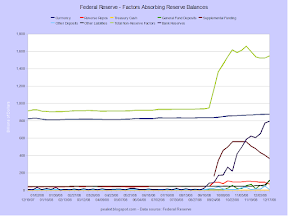 Zooming in on the past year and eliminating the total liabilities line highlights how completely unprecedented recent developments are.
 The asset side of the balance sheet is operating in uncharted territory as well.
 Here's a stacked view of liabilities.
 And a stacked view of assets.
 A composition breakdown of liabilities shows the rapid growth of non-currency items.
 And finally, the breakdown of assets shows the rapid fall of Treasuries as the primary holding.
As you may have noticed, I have reversed the normal pattern of listing assets before liabilities. That's because the Fed really has been trying to acquire cash (liabilities) before it acquires stuff (assets). Which is to say that the Fed is NOT "printing" - at this point. All the money it is pumping into the economy by buying up assets (trading cash for stuff) is being drained on the other side by taking on liabilities (trading stuff for cash, or sucking in cash.) The balance has been perfect for the past 6 months to two decimal places - though there are small fudge factors deep in the numbers on both sides.
The other thing you may have noticed is that currency in circulation is considered a liability. It is, and it's a non-interest-bearing one. When the Fed adds cash to the economy, it buys an equal amount of stuff (assets). Looking at it the other way, the regional Federal Reserve branches have to buy cash, which they need because people want to conduct transactions. And they need more and more of it because in a growing economy people are conducting more or more valuable transactions every day. If the Fed gave away cash for free, the regional banks would request what they needed and a whole lot more, and cash would become worthless overnight. Instead, the Fed makes the regional branches cough up something of value, which they originally got from various commercial banks in return for the last round of cash. And on down the line. Thus the Fed acquires a pile of interest-bearing assets (somebody else's liabilities), and uses the income stream from the pile to fund its operations. The net of interest minus operating costs is sent to the Treasury.
But wait, you say, don't the Fed's assets consist mostly of Treasuries? (Pay attention here because it's going to get weird.) Yes, it does. And thus, when the Fed buys Treasuries, it takes most of the government's interest rate exposure out of the public's hands, with only the cost of the Fed's operations still flowing out into the economy. For all intents and purposes, the debt disappears because the Fed hands out non-interest-bearing debt in the form of cash when it gets the Treasuries. So what's the point of having the Federal Reserve if the Treasury is essentially paying itself for it's own debts? Well, we want the Fed to be independent in its operations, not be subjected to the immediate whims of politicians. A very extreme example of the results of non-independent monetary policy can be seen in Zimbabwe. The Fed, in contrast, is charged with maintaining stable prices (and full employment, but that is another discussion) and politicians have no easy way of changing that mandate. This makes it unlikely that the institution will print gobs of money to pay off the federal government's debt. And as bad as the federal government's balance sheet is, hyperinflation is a lot worse.
Theoretically, the Fed could sell off all of it's Treasuries and try to suck back all the dollars it has sent out over the years. In the past it has done this occasionally on a very small scale when it thinks the money supply is growing too fast. But lately it has been doing something else. It has been selling Treasuries for cash, but then immediately shipping the cash back out for a different set of interest-bearing assets. The specifics of these new assets are largely unknown, but the charts above show the broad classes. It also has acquired cash from two new sources. One is the Treasury, which sold off a pile of brand new Treasuries specifically for the purpose of putting the money in its checking account at the Fed. The Fed used this cash to buy new assets as well. Finally, commercial banks have put a huge amount of "excess" reserves into their accounts at the Fed (at the regional branches, to be precise). Once again the Fed has been using the new cash to buy assets.
So what's the problem if everything balances out? It turns out there are three problems. First, it re-exposes the federal government to principle and interest liabilities that were once hidden in the Fed. With the public now owning the Treasuries that once were at the Fed, the interest payments no longer magically reappear in the pocket they just came out of. Since these Treasuries are mostly short-term issues, there is also the danger of not being able to roll them all over. Second, the Fed is paying interest on the excess reserves. A note on these reserves. The reason the banks have all this extra dough is they aren't lending. Remember the credit crisis? Here is proof that is quite real. The Fed has basically said: okay, since you guys won't lend, I'll borrow your cash and lend in specific credit markets that you pansies are too chicken to enter, and I'll make sure you lend me the extras by paying interest on what you deposit. Normally banks only have between $5B and $30B of reserves at the Fed. Now it's around $800B, and the annual interest on that will be at least $2B. While that amount is a lot less than the $15B the Fed is on track (or was, as of Dec 1) to return the the Treasury this fiscal year, but it's still a lot of money. Which brings us to the final problem.
The third problem is only a potential one at this point. As I said above, we don't know exactly what the Fed has hoovered up, so we don't know if the assets will perform, meaning provide a stream of payments of interest and, possibly, principal. The Fed might have bought junk at a discount. The Fed might have bought junk at face value. The Fed might have been choosy and selected only the best assets. The Fed might have driven a hard bargin and bought great assets at fire-sale prices. We don't know. If the assets perform poorly, the Fed will have a hard time meeting its interest obligations. If they blow up, perhaps because the issuer goes bankrupt, the Fed will have a real problem. The interest and principle would disappear, but the corresponding liability would still exist. But since the Fed is, you know, the Fed, it can't short any of its creditors. Fortunately, about one-third of the new liabilities are deposits by the Treasury, and it's highly unlikely the new assets would decline in value so much that new borrowing by the Treasury would be needed. Any gap between the assets sold and the liabilities paid off would just end up as another liability of the American taxpayer.
So, by looking at both sides of the Fed's balance sheet, it seems pretty clear that the Fed is not doing Zimbabwe-style printing. All the "innovations" are being "sterilized", meaning there is no new currency being issued. Right?
 Well, maybe not. The M0 (currency) line shows a definite uptick for that measure. M1 (M0 plus checking accounts) is definitely way up. But M2 (M1 plus savings accounts, small time deposits, and money market deposit accounts) growth isn't as high, and while the MZM (M2 minus time deposits plus all other money market accounts) was high earlier in the year, it's growth has come down.
 A broader time frame provides some needed context. M1 growth is still notable, but the other measures are growing less fast than they have at various times in the past.
 Zooming out the the full extent of the data shows some freaky action in the MZM measure during the early 1980s.
 So why is M0 up? Because the Fed hasn't stopped issue currency, and is actually doing so a little faster than before September. Over the time period for which I have both sets of data, the two measures track identically. That's expected. In light of this, inspecting the first and third graphs does reveal a slight upward movement of the currency lines near the end of the time frame. But the last graph shows that the M0 growth rate is not unusual - so far.
Frankly, I think it's too soon to decide if there is a new trend in the money supply. And I also think that it is possible that some of the growth is from people switching their preferences for financial assets towards what they perceive as safer instruments, such as bank deposits and physical cash. The economy is certainly not growing, but yet the demand is still there. So out the door the dollars go. Whether the Fed sucks extra dollars back in when the economy starts to grow or lets them float about and create some inflation remains to be seen.
Friday, December 5, 2008
Nationalization Now!
My considered, but possibly unconstitutional, not to mention probably unworkable, proposal to fix the banking system:
- Stop trading of all bank stocks.
- Declare all deposits and all debt issued by banks to be government guaranteed for the next 5 years.
- Require all banks to write down all mortgages issued after 2000 by a formula determined by zip code, valuing the home at the same variance from the 2007 median but relative to the 1997 median extrapolated by CPI+1%.
- Buy all underwater or non-performing mortgages at the new values off the books.
- Offer to buy MBSs and similar toxic waste from all non-banks at the same write-down level.
- Work through the books of all banks to see which are still solvent starting at the bottom of the size scale.
- Let trading resume on solvent banks.
- Nationalize insolvent banks (public or private), wipe shareholders, clip bondholders, and revoke warrants.
- Recapitalize insolvent banks and set up a schedule for selling them off.
- Work through bad mortgages, offering a) principle write-downs with a shared appreciation clause to people who were more-or-less responsible and are relatively solvent, and b) one-step non-judicial bankruptcy with repossession, a non-pursuit agreement, and a rent-back offer to the irresponsible and/or hopelessly insolvent. Fraud by any borrower should be pursed.
- Set up a schedule to sell off government-owned properties.
This plan focuses on residential mortgages. Of the other four big distressed classes, CRE mortgages can be treated in similar manner with more case-by-case decisions. LBO loans are often made by highly speculative players, so the government should take on those loans only if it is providing DIP (debtor-in-possession) financing as well. The total amount of consumer credit (primarily credit cards) and auto loans outstanding is much less, as well as being too fine-grained to be worth working through, so borrowers and/or creditors will to have to deal with those on their own.
Obviously, this proposal screams "MORAL HAZARD" at an ear-shattering volume. But we are way, way, way beyond the point of being able to limit the harm to those who were "irresponsible." The money is gone. *Poof* Time has come to accept that and get the banks back to a point where they can (and will) loan again. On the plus side, it does mete out a bunch of harm to shareholders who let lending get out of hand.
The unworkable aspect of this plan is assembling sheer number of appropriately qualified workers that would be needed. There are a lot of newly unemployed financial services workers floating about. But locating them, leasing enough workspace, equipping them with computers, providing instructions, and setting them to work would be a huge and time-consuming task. The workers at the ratings agencies, the latter having proved themselves to be completely useless, could (should) be dragooned in place to provide a jump start. But the task would still remain daunting, to say the least.
Monday, September 22, 2008
Open Letter: Bailout Bill
Dear Senators and Representatives,
I am writing today to urge you to oppose the ridiculous financial bailout bill proposed by the Bush Administration and Secretary of the Treasury (and former Goldman Sachs CEO) Hank Paulson. It is easily the most naked power grab in the past quarter century, and if passed as-is, it will go down as the Bush Administration's third biggest screw-up (after Iraq/Afghanistan and Katrina). The plan is undemocratic, unaccountable, and fundamentally unwise. The rush to get it passed is a scare tactic aimed at bullying Congress into passing something that favors Wall Street. We saw something similar before the Iraq war, and we know how that turned out.
The plan as currently proposed almost certainly won't work. Buying the various CDOs, MBSs, and other financial instruments at “market value” would still leave many banks under-capitalized and thus insolvent. But buying the financial instruments at face value would be a huge give-away to Wall Street and other financial gamblers. The only way to avoid a huge giveaway, eliminate the moral hazard, and keep the system functioning is to take over every institution with a whiff insolvency, recapitalize them directly, and manage them until the financial instruments mature and the firms are solvent. It would be ugly, but the American financial system is broken. But so is the idea that unfettered free market capitalism exists in American, or that it works. That has been proven false by very people who most support it – Republicans and Wall Street.
Here are the conditions that I think should be attached to any bill, no matter the details of how the “bailout” is implemented:
- It should include a way of at least partially paying for the huge bill the taxpayers will inevitably shoulder. I suggest a) repealing the Bush tax cuts, b) resetting the capital gains tax to the pre-1997 levels, and c) implementing a low (0.01% to 0.05%) transaction tax on all stock, bond, option, future, etc. sales (the UK already has a sales tax on stocks and it hasn't harmed the London stock market).
- It should include a provision to break up anything that is too big to fail.
- It should include a provision to regulate anything that functions like a bank as a bank.
- It should be completely transparent and have accountability. All transactions should be posted on the web immediately. Congress should get weekly reports on what has happened, why, and what the next week's plan is.
Talk about limiting CEO compensation may feel good, but is basically irrelevant at this point, as is talk about “claw-backs” - recovering past unwarranted compensation. Helping homeowners should also be separated as it muddles the issues. The focus needs to be on rebuilding the financial system from the top down with a more small-c conservative culture. Thank you for your time, and I look forward to rational action on your part.
Subscribe to:
Posts (Atom)