While there seems to be a temporary lull in Eurozone action, I
don't think the developments on Friday and over the weekend amount to a turning point. Installing "technocratic" elites doesn't make a lot of sense, because it was unaccountable technocrats who created the mess in the first place. That the specific technocrats have links to Goldman Sachs, which arranged the accounting fraud
that allowed to Greece to enter the Eurozone in the first place,
doesn't inspire confidence, either. Stergios Skaperdas has written
another op-ed on Greece leaving the Euro. I
wish Greek politicians would read it but, like national-level politicians
everywhere, they seem to be tightly encased in their own little bubble. Even when they make noises about the austerity being imposed on the country, it is to position themselves in the next election, not because they have a better alternative.
The most immediate impact of the change of Prime Minister in Italy has done is given everyone a chance to write about how awful Silvio Berlusconi has been for Italy. It's not a new topic; people have been writing about Italy's Murdoch+Buffett for years. A lot of Italy's "structural" problems would have existed if he had stayed out of politics. And some of the uniquely Italian problems have been around for decades. But having as Prime Minister someone who was arguably in politics to keep himself exempt from prosecution as much as anything else has taken amoral familism to a new level.
So while having Silvio gone will improve Italy's long-term prospects, in the immediate future the problem is basically one of math. Unless bond rates come down, and the economy either grows or inflates (a.k.a. currency devaluation), Italy will probably join Greece in exiting the Eurozone. The problem is that the economy is unlikely to grow fast enough to convince bondholders to accept lower rates. And the ECB is still the ECB, so it's unlikely to help in one way or another. That has prompted more calls to end the common currency. Both a recession in Europe and a collapse of the Euro would affect the United States, something the country can't really afford on top of our own past and potential future stupidity.
Showing posts with label International. Show all posts
Showing posts with label International. Show all posts
Monday, November 14, 2011

Wednesday, November 9, 2011
Mio Dio, Cosa Hai Fatto, Silvio?
The ever-wise markets seem to have skipped ahead in their script by a few countries, because today the world woke up to find Italy on the verge of financial ruin. Or at least that's what everybody is saying the markets are saying. Unfortunately, as long as everyone believes it to be true, it's likely to come true.
I find it suspicious that right after the Greek mess has been "resolved" that the Italian crisis would suddenly come to a head. Shouldn't the agreement of the Greek parties to unite to screw the Greek people give everyone else at least a few weeks of relief? Apparently not. Nothing else about Italy's underlying financial condition, which isn't that bad, has changed since last week. But sharply increasing yields means that whenever Italy has to roll some debt, which most indebted countries do on a regular basis, it will have to pay substantially more. Thus the problem in Italy has become self-fulfilling.
The failure to resolve the crisis is mostly the European Central Bank's fault. It has basically refused to do the job of a proper central bank, which is to regulate the macro economy for the greater good. The origins of the crisis are much more structural, which quite a few people still don't understand. But rather than do the right thing and forgive gobs of debt, or exit the Euro themselves, the core Eurozone countries may be to be planning to kick the GIPS countries out. I can't see how that would be a good solution economically or politically. Not only would it create immense amounts of ill will in the region, it would still leave the GIPS countries with their external debt denominated in a foreign currency. That class of debt is the only justifiable reason for Greece not leaving the Euro that I can see, and forcing the issue on multiple countries at once couldn't possibly help.
If things do really unravel in Europe, which they haven't done quite yet, I think US markets won't entirely collapse due to flight-to-safety inflows. I could easily be wrong about that, though. But obviously a breakdown overseas would fall through to front-line jobs within weeks, and that would exacerbate what is already a crisis.
Update 2011-11-09: Italy's problems may very well be Silvio's fault.
Update 2011-11-10: Italy's bond sale was successful but at a rate that is a good deal higher than last year.
Thursday, November 3, 2011
More Χάος
News is breaking on an hourly basis in Europe these days, with Greece still being the center of attention. The latest loop is the sudden appearance and disappearance of plans for a referendum on the bailout and austerity measures being put to the Greek people. It is quite likely that Papandreou was bluffing his fellow politicians into joining him in sharing the political pain, which he may have done successfully.
As I said over here, I just don't see how the situation can be sorted out while Greece still uses the Euro. I don't know how much adjustment of one kind or another is necessary to bring Greek labor costs down to where they are in line with the productivity* of its workers, but I suspect it is a lot. And by a lot, I mean 15-30%. Deflation by that amount implies that as long as Greece still uses the Euro, its citizens will, on average, have to take pay cuts of 15-30%. This would be painful but not devastating if individuals and businesses were basically debt-free. But that's not the case in Greece, though it must be said that they aren't close to being the most indebted. But debt doesn't automatically shrink when wages and prices deflate. In fact, the real burden goes up. And substantially greater real burdens means substantially more foreclosures, bankruptcies, and corporate bond defaults. That's why devaluation makes a lot more sense, and which would happen automatically in the markets if Greece still had its own currency - provided, of course, nobody is manipulating their currency.
So the mystery continues - why are Greek politicians pursuing such awful policies?
* - saying that Greeks are less productive doesn't mean they don't work long hours. It just means that for one or more reasons their output is less per hour.
Monday, September 26, 2011
Another Dismal (Social) Scientist
Via Atrios comes this short column in the Guardian by Stergios Skaperdas that goes into a bit more detail about the mechanics of a Greek default and exit from the Eurozone. The shorter on the column is: default is better than massive deflation, and default will bankrupt Greek banks, and to recapitalize them Greece will need its own currency, and it will have to institute tight currency and capital controls for a while, and all of that requires planning, which hasn't been started as far as anyone knows. So, either the Greek government is executing masterfully, as evidenced by there being no indication whatsoever that it is about to default, or it is failing the Greek people. I'm going to say it's the latter, as governments are failing their citizens all over the place these days.
The Dismal (Social) Scientist
I think Krugman is getting a bit frustrated. Well, more frustrated. So frustrated, in fact, he Godwined-in-all-but-name his own column. Today he also comes about as close to calling the Eurozone elites idiots as is possible within the NYT's civility rules. He's done so more-or-less explicitly on his blog, but that probably has a readership that is smaller by a factor of 10 or 20. Maybe a more prominently-place tongue-lashing will have an effect, though I wouldn't count on it.
One reason for Krugman to lash out is that The Big, Fat Greek Depression continues. The NYT has a good color article today on what the austerity is doing to the typical Greek family. Real household income for the Firigou family has fallen about 40% between pension cuts, salary cuts, and increased taxes. But at least they still have income. Lots of families are undoubtedly doing much worse.
I still haven't found a good explanation for why the Greek government, which is currently controlled by the nominally left-wing Panhellenic Socialist Movement, refuses to default. Is it national pride, or are they genuinely worried about private external debt problems? Those would remain, and get much worse, if Greece defaulted and switched to a new currency. I suspect most wealthy Greeks have transferred most of their liquid wealth to some other location, so that reason should not be holding the politicians up. It's a puzzle I can't crack from afar.
ETA: Some schnitzel from Germany expects Greece to suffer for a whole decade? That will certainly happen if it doesn't default. On the up side, the Italian Economy Minister Giulio Tremonti is pushing back on Germany's approach pretty hard, at least in that article.
Thursday, September 22, 2011
Default Already, Dammit
This is fucking nuts. The Eurozone is experiencing a self-inflicted disaster, but the perpetrators won't be made to pay.
Update 2011/09/23: Krugman lists some of the perpetrators, and then wonders about the social dynamics inside those organizations. It's a good question. It seems to me that in the West, the financial industry has triumphed in several countries, most notably the US and the UK. And there have been conservative governments in many countries which have appointed conservative-leaning people to those institutions. Those countries include the US (2001-2009), Canada (2006-present), Germany (2005-present), France (1995-present), Australia (1996-2007), and Italy (2001-2005 and 2008-present). The UK also had a nominally left-wing but very finance-friendly government from 1997 to 2010, when the Conservatives took over. Ditto for the US from 1993 to 2001. The policies and opinions of the international financial institutions (BIS, IMF, ECB, and WB, plus the OECD which is a data and analysis operation) reflect those factors. The low-inflation, low-regulation leanings of the leaders have filtered down from the top, as well as in from the side, though lower-level channels, from the finance industry, which those organizations deal with on a regular basis.
Update 2011/09/23: Krugman lists some of the perpetrators, and then wonders about the social dynamics inside those organizations. It's a good question. It seems to me that in the West, the financial industry has triumphed in several countries, most notably the US and the UK. And there have been conservative governments in many countries which have appointed conservative-leaning people to those institutions. Those countries include the US (2001-2009), Canada (2006-present), Germany (2005-present), France (1995-present), Australia (1996-2007), and Italy (2001-2005 and 2008-present). The UK also had a nominally left-wing but very finance-friendly government from 1997 to 2010, when the Conservatives took over. Ditto for the US from 1993 to 2001. The policies and opinions of the international financial institutions (BIS, IMF, ECB, and WB, plus the OECD which is a data and analysis operation) reflect those factors. The low-inflation, low-regulation leanings of the leaders have filtered down from the top, as well as in from the side, though lower-level channels, from the finance industry, which those organizations deal with on a regular basis.
Friday, September 9, 2011
Bestest Grafick Evah
From this Robert Reich op-ed, which is good, comes the graphic below, which is great.
 This is the best summary of the negative trends that have pinched the middle class over the last 35 years. The point about women working comes across as slightly sexist, but I don't think the equivalent data for both sexes (dads can stay at home, too) exists, at least for the time period involved. So the excellent NYT graphics department used the best available series.
We've been running the Republican experiment since the 1980s - cut taxes, cut social spending, cut public investment, increase war and security spending, and outsource much of the latter - and it hasn't produced good results for the majority of Americans. The underlying trends - globalization, computerization - would still exist if we had stuck with Democratic policies, but overlaying Republican policies on those trends has amplified them. Capital moves quicker and farther than labor, and giving more capital to the rich has only allowed them to shuffle it around with greater ease, dragging jobs with it.

We've been running the Republican experiment since the 1980s - cut taxes, cut social spending, cut public investment, increase war and security spending, and outsource much of the latter - and it hasn't produced good results for the majority of Americans. The underlying trends - globalization, computerization - would still exist if we had stuck with Democratic policies, but overlaying Republican policies on those trends has amplified them. Capital moves quicker and farther than labor, and giving more capital to the rich has only allowed them to shuffle it around with greater ease, dragging jobs with it.
Wednesday, August 10, 2011
Is Our Central Bankers Learning?
Twice in the past three days, important central banks have actually done something slightly positive. Sunday night it was the European Central Bank deciding to intervene in the Italian and Spanish sub-sovereign bond markets. Yesterday it was the Federal Reserve setting expectations on how long it plans to keep its current low-interest rate policy. The ECB's intervention has worked, at least temporarily, as the interest rate premiums for both countries vs. Germany have dropped sharply (divide the numbers by 100 to get real world units). The Fed's statement was aimed at general sentiment, not any specific index, so it's a little early to say if it worked.
In both cases, however, the gap between what is being done and what should be done is still far too wide. Hopefully, these two actions were just first steps towards more sensible policies.
Update: 2011.08.11: Yves Smith talks about the central bank actions.
In both cases, however, the gap between what is being done and what should be done is still far too wide. Hopefully, these two actions were just first steps towards more sensible policies.
Update: 2011.08.11: Yves Smith talks about the central bank actions.
Thursday, August 4, 2011
She's Got a Trichet to Ride
Megadiving in the markets today. Nobody knows for sure what fears live in the hearts of market makers, but today it seems to be goings-on in Yurp, where the German-Italian bond spread continues to balloon. The ECB's policies have been disastrous, predictably.
The most interesting proposal to resolve the crisis is this one from Ambrose Evans-Pritchard. Generally I find AE-P to be a bit of a breathless blowhard, but at first glance the idea that Germany should withdraw from the Euro is quite intriguing. Germany, along with a few others in concert, are more likely to be able to pull off a orderly withdrawal because they are more likely to be able to keep the whole thing secret. Discretion during any unplanned currency switchover is very important, because public knowledge is likely to trigger a bank run. (The situation is different if the changeover is announced years in advance, as happened with the formation of the Euro.) The new currency - lets call it the nordmark - would appreciate against the rump Euro, allowing the South European countries to regain competitiveness and grown their economies without suffering through years of deflation first..
As always, reality is likely to be a lot more complicated, so such a move may end up making everything worse compared to organizing bailouts and haircuts and other such things within the existing currency union. Or individual countries in the so-called PIIGS quintet may be better off going their own way. Dunno. But like the auto bankruptcies here in America, whatever happens should happen in an organized manner, because we know that chaotic failure will produce the worst outcome. And right now Germany and its proxy the ECB are steering the Eurobus towards a cliff.
Tuesday, July 19, 2011
Et vos, Italia?
People have been talking about Italy's problems for years, but about two weeks ago they suddenly burst into the news for some reason - due to either a coordinated attack by speculators or squabbling within the governing coalition. And the by now predictable response: an austerity package, passed on Friday. Early in the week an important part of the bond mafia indicated that the markets would be reassured by such budget-cutting moves. But that wasn't the case in Ireland or Greece, so such declarations seem premature.
As in Greece, and Ireland, and the other countries in trouble, there are real problems in Italy. The net national debt is currently over 110% of GDP. The current Prime Minister, Silvio Berlusconi, manages to combine all the negative aspects of Rupert Murdoch, George Bush, and Anthony Weiner in one human body. The country is easily the most corrupt major EU country; only Greece ranks lower out of the 27 countries in the union.
Of course, that's not the whole story. While the Italy has a high level of debt, it has been able to sustain it for over a decade now. Because the country has had a relatively high savings rate, the debt is mostly internally financed and its net foreign investment position is nearly neutral. Despite pervasive corruption and a political culture that is a complete mess, it has still managed to raise its citizens' (adjusted) per capita income to over 30,000 dollars, and it is a top 25 country in the Human Development Index.
I would say that like America, Italy's problems are mostly politi-cultural. But that doesn't mean that market forces can't force a crisis. Italy is a relatively populous country, and its bond float isn't trivial. But it doesn't necessarily take that much money to move markets. So the "crisis" is likely to continue as long as bond traders are able to exploit the market for personal gain at the expense of taxpayers.
Update 2011.07.22: Calculated Risk reproduces a Bloomberg chart that illustrates the futility of bailout packages (which included austerity measures) in other countries.
Update 2011.08.06: The Economist said it better. And it turns out that Italy has the third largest sovereign bond market (or sub-sovereign, because Italy doesn't issue its own currency). However, the amount that is likely to be traded could be much smaller.
Tuesday, July 12, 2011
Predictable Expectations
ATHENS (Reuters) - A deeper-than-expected recession caused Greece's central government deficit to widen by almost one third in the first half of the year, widely missing an interim budget target under the country's bailout plan, the finance ministry said on Monday.
...
Hurt by austerity, the Greek economy contracted at an annual pace of 5.5 percent in the first quarter. The Greek government revised downwards its 2011 growth forecast for this year to 3.9 percent.Hoo-boy, another nobody-could-have-predicted moment. Of course, it's not. The Greek economy is going to contract until the cutting is stopped, or until it re-adopts its own currency.
Update 2011.07.12: As always, I'm hardly the first one to make the observation.
Hacktacular
The ongoing phone-hacking scandal in the UK is just mind-blowing. Kudos to the Guardian and its staff, whose dogged investigative work has brought all of this to light.
Wednesday, June 29, 2011
A Greek Tragedy
It really didn't have to turn out like this. After a couple of years the internal discussions will leak out, and we'll get a better sense of why the current government led by (and consisting entirely of) the Greek Socialist Party pushed these draconian neoliberal reforms (liberal as in as in classical liberal, not American librulz) on the country. The only justifiable reason I see is that the leadership of the party thinks that they can't pull off a switch to a "new Drachma" because it would be impossible to keep it a secret long enough to implement the change successfully. But I don't believe that will turn out to be the real reason, or at least the main one.
Update 2011.06.30: An article from the BBC explains why Greece can't default as long as it continues to use the Euro. As long as the primary budget - the budget minus interest payments - is unbalanced, default is not possible because the Greek government is depending on more loans of Euros to pay its employees and vendors for the foreseeable future. The neoliberal economic organizations that are pushing the austerity package on Greece in exchange for the loans are projecting sufficient positive economic growth to bring the budget into surplus, when coupled with spending cutbacks. But as we've seen in the UK, cutting government spending (demand) when there is insufficient private demand to make up for the cuts leads to economic contraction. It's a vicious circle: cuts lead to slowdown which reduces revenue which increases the deficit which leads to more cuts. So the latest package just another kick at the can.
Update 2011.06.30: An article from the BBC explains why Greece can't default as long as it continues to use the Euro. As long as the primary budget - the budget minus interest payments - is unbalanced, default is not possible because the Greek government is depending on more loans of Euros to pay its employees and vendors for the foreseeable future. The neoliberal economic organizations that are pushing the austerity package on Greece in exchange for the loans are projecting sufficient positive economic growth to bring the budget into surplus, when coupled with spending cutbacks. But as we've seen in the UK, cutting government spending (demand) when there is insufficient private demand to make up for the cuts leads to economic contraction. It's a vicious circle: cuts lead to slowdown which reduces revenue which increases the deficit which leads to more cuts. So the latest package just another kick at the can.
Thursday, June 23, 2011
Take This Job And Add It To Your To-do List
Via a plug post by Drum comes this article from Mother Jones, entitled The Great Speedup, on how employers are squeezing the employees they haven't fired to do more work. It covers two topics I've touched on before: the much greater number of hours Americans spend working, and the lack of worker protections that enables employers to put the screws to employees. Lots of people forget (and lots of people work to make them forget) that the point of economic activity is allow people to live their lives, which includes the non-economically productive portion. The point of economic activity is most definitely not to create impressive numbers on corporate reports, even though the business news channels say otherwise. It really doesn't matter if corporate America is setting record profits if there is chronically high unemployment and under-employment. That contrast means that something is amiss in how economic activity is structured right now in this country. Keep in mind that the differences between the US and other countries are due to conscious policy choices, even if few people are aware of when choices are being made for them.
Monday, June 20, 2011
Take This Debt and Shove It
In response to this article about the crisis in Greece, recovering economist Atrios wonders why the Greeks don't default on the huge amount of government debt that the country will never be able to (entirely) repay. The answer is (probably, I can't read the minds of Greek politicians) that there are competing interests in every country. It's safe to say that Greek politicians and the Greek elites (whoever
they are) haven't been acting in the people's interest over the past
decade, given the bookkeeping fraud and tax evasion perpetrated by the
two groups. So, for some reason the Greek politicians must not see it in their interest to default, or at least default right now. They may change their minds due to factors like being threatened by rioters, or finishing the transfer of their assets to Malta.
In general I remain a bit surprised at just how much the ECB is being run in the interests of Germany and the other core countries (NL, FR, and perhaps BE). That's been happening for months now. As bad as unemployment is here in the US, it is much worse in Spain and other countries at the periphery of the Eurozone.
Update 2011.06.23: Krugman summarizes the case for default in one handy graph. Greece is not Argentina, of course, and global economic conditions are quite different now compared to 2002. But the outcome for the Greek people is guaranteed to be better than suffering through years of austerity-induced economic contraction.
Saturday, December 12, 2009
It's Over
Fail.
This doesn't mean I won't stop trying to slow anthropogenic climate change. But from this point forward all major planning exercises should include a worst case scenario for global warming. For instance, with respect to HSR, route selection should consider a ten foot (three meter) sea level rise and a 50% increase in the maximum predicted storm surge. The new design assumptions wouldn't affect just projects on the Gulf Coast and in Florida; there are also extensive low-lying areas in the San Francisco and NYC regions. Something that will have to be considered everywhere is water, as much of the US will become drier. Of course, there is always a chance that new technologies will come along in time to save us. There is also the chance that humans will fully grok the problem in time to change, but it's much smaller. The political and cultural dynamics at play are don't give me much hope.
Update 2009/12/16: Sites expected to be in use or toxic for more than 200 years should take into account a full 33 foot (9 meter) rise.
Saturday, June 20, 2009
Weran Amok
(I try to keep politics out of this blog for a number of reasons, but nonetheless....)
I wish the people of Iran the best. I really do. Some observations.
- Right now nobody outside of the Iranian government really knows what happened with the vote.
- The election procedures as I understand them from the reports definitely look fishy.
- The Iranian protesters don't seem to want radical change; they want an explanation of what happened in this election.
- The protesters appear to acted overwhelmingly (if not completely - though any exceptions could be government provocateurs) in a calm and dignified manner.
- The reactions of the government look desperate and are completely ham-handed.
- Mousavi has a less than stellar record.
- The president in the Iranian system isn't as important as some people seem to think.
- Contrary to the opinion held in some quarters, Iran and the Iranian people aren't our enemies. Iranians had a legitimate complaint about the U.S. government in the late 1970s, and then again in the 1980s. Since then it has served the purposes of both American and Iranian politicians to continue the verbal sparing.
- We are fighting two wars in countries that happen to border Iran, so we cannot afford to significantly antagonize either side.
- Obama is right to say the foreign policy of Mousavi and Ahmadinejad would not be that much different (though tone does matter).
- Obama has played this right and Congress - most notably McCain - has not.
- We should butt out because we have enough problems to fix already.
- The demographics say that even if Ahmadinejad wins this time the next election will bring significant change.
Update 2009/06/29: Well, our ADD press has moved on from Iran to newer coups and the deaths of various celebrities. I'm pretty sure we in the U.S. won't know what really happened in the election for years. Regardless, the existing regime survived, and I think that is bad both for Iranians and the US. Tone matters, and Ahmadinejad has used the US as a foil for years. Obama won't take respond in kind for now, but he has set a semi-firm deadline at the beginning of next year for "action" on Iran's alleged nuclear program. The old pattern of unnecessary antagonism is likely to resume then.
Thursday, June 4, 2009
A Long Way to Go
Have far have we gone on the road to re-balancing the economy? Not far at all.
 We're still consuming far above the 1946 to 1996 average. (I chose not to include data after 1996 because 1997 is when it all started to go really wrong - though it doesn't show up in the data until 1998.) We're also consuming more than our equally bankrupt friends in the U.K., and far more than our sober peers in CA, JP, and the Eurozone (on average - the numbers vary widely within the zone).
I suppose I've become a bit of a crank on this (at least in the privacy of my own home), but it can't be stressed enough how painful the transition to a sustainable economy will be. Americans are not mentally prepared for what is to come.
Wednesday, December 17, 2008
Lump of Lines
I ran across the "lump of labor" fallacy again the other day, and it got me thinking about international comparisons of work-life tradeoffs. So I tracked down some data and made some graphs. And without further ado, here is my latest set of squiggles.
 The first graph shows relative gross domestic product per capita, or per resident. The United States is the baseline, and is represented by the big straight line. The ratios for most industrialized countries stabilized in the early 1970s. The outliers are Norway, Korea, and to a lesser extent Spain. Norway is a small country which discovered a lot of oil in the 1970s. Korea by far was the poorest in 1960, and also has reduced the difference with the United States the most. Spain was the poorest European country shown and still is, though Italy has declined recently to nearly match it.
 The ratio of GDP per worker is more significant because it shows the relative productivity of workers in each country. Again, the United States is the baseline, with Norway and Korea remaining outliers. These ratios stabilized somewhat later than the per capita measurement, in the early 1980s. The ratios then fell slightly in the late 1990s and the 2000s. My guess is that the widening reflects the two speculative bubbles in the United States, not real productivity increases by it's workers.
 The employee to population ratio is important for overall wealth of a country, as more workers can obviously produce more goods and services. There seems to be three loose patterns: Japan and the Nordics have maintained a high level, France and the other Latins have maintained a lower level, and the Anglos have increased. A ceiling for the ratio may exist at slightly above 50 percent. Korea again is the outlier at the bottom.
 The data for the next two graphs is less complete, but quite interesting nonetheless. It shows that most other industrialized countries have reduced the amount of time workers spend on the job, relative to the United States. Korea continues to be an outlier, though this time on the high side.
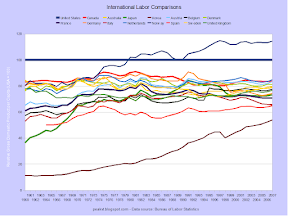
 Americans have been working the same amount since the middle 1970s, but the downtrend continued in several other countries until as late as 2000. The Dutch and the Deutsche now work about 9 hours per week less than Americans, if the workyear is 50 weeks long. It usually isn't, as most European countries guarantee several weeks of paid vacation per year for all workers. The Koreans work a crazy 45 hours per week using a 50 week workyear.
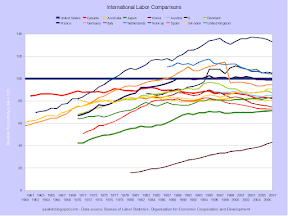 Using the workweek and per worker GDP, relative productivity can be derived. Workers in several countries have surpassed Americans, though the gap narrowed during the past decade. Korea, once again, is an outlier on the undesirable side. Germany experience a large drop in productivity when data from the unproductive formerly communist economy of East Germany was merged with that of the larger western portion.
 In this single year view of 1987, the bunching around the 80 percent line can be seen.
 Moving to 1997 shows a relative gain by most countries. (Go to my Picasa page to see the changes better.)
 2007 shows most countries falling back slightly. Again, I think the widening gap is due to America's bubblicious economy, not real productivity gains.
 Going back to 1977 shows the long-term changes.
One factor may contribute to the appearance of higher productivity in America - the country produces less per unit of energy. Compared to other OECD countries, America has long had plentiful energy resources. The UK and Norway didn't start producing from their major oil fields until the l970s, and nobody matches America for coal deposits. This appearance of abundance (it's transitory) has led Americans to be less concerned about energy use, and a lot is wasted. However, the excess use shows up positively in the GDP numbers.
Someone once quipped (roughly) that Americans consume cars, while the French consume vacations. It's hard to dispute that most other OECD residents work less than Americans. And with slightly lower productivity, the result is most countries produce about 80% of US per capita GDP. The most notable outlier is Korea, where workers produce a lot less despite working considerably more hours per year. My sense is that Korea business are able to provide their workers with equipment that matches equipment in other countries, so I am at a loss to explain the significant difference. Norway is an outlier on the other end, but that is explained by the North Sea oil fields.
The choice of free time over stuff is a value judgment, of course. However, in most debates in this somewhat stupid country, the trade-off is forgotten and the focus is on the headline number: per capita GDP. But, as the saying goes, in the long run we're all dead, so I think time is more valuable - and I have arranged my life to reflect that.
A few side notes. First, all these numbers are based on purchasing-power parity (PPP) conversions, and thus are estimations. Calculating PPP requires some value judgments and thus gives different results from exchange conversions. Second, despite its prowess at manufacturing, Japan never "caught up" with the United States under PPP comparisons. The collapse of the property and stock bubble around 1990 is probably the main cause, but Japan has a number of structural problems that have lingered for even longer. Third, Italy has show a significant relative decline. It too has a number of structural problems - probably even more than Japan.
Subscribe to:
Posts (Atom)